A closed ticket. An open question.
When you report a pothole or drainage problem, the city eventually marks it ‘closed’ — but closed doesn’t always mean fixed. LocalPulse shows you what actually happened.
Follow official 311 requests across Baton Rouge and New Orleans. See the city’s recorded status, add what you observed, and keep both sources visible over time.
Browse public records freely. Sign in when you’re ready to add an observation.
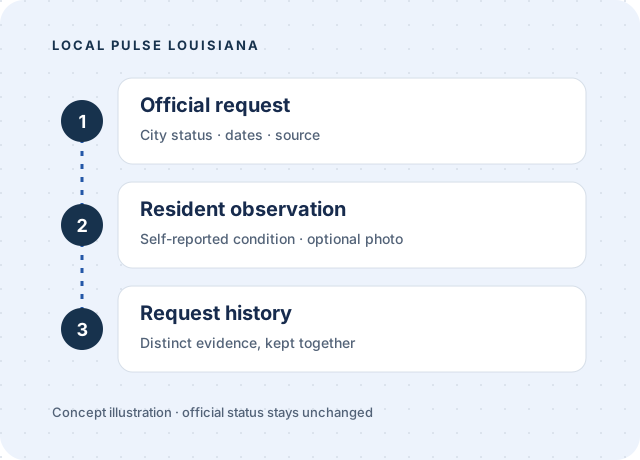
How it works — in 3 steps
One request. Two sources. A clearer history.
Understand what the official record says and what residents independently observe.
Inspect the official record
See the city’s recorded status, dates, department, source link, and data freshness.
Add a resident observation
Share whether the problem is still present, appears fixed, is partially fixed, or you’re not sure. Include an observation date and an optional photo.
Read the history
Follow official events and community observations together, with each source clearly labeled.
A closed ticket does not confirm a repair.
Resident observations never change the city’s official status.
Explore by city
Pick a city, then start with a council district, an official request, or recent activity.
District comparisons
Explore request volumes and waiting times across Baton Rouge’s 12 Metro Council districts (1–12).
Compare districtsOfficial request map
Find an open drainage request, inspect the official record, and add an independent observation.
Explore the request mapA reviewed history
Two Baton Rouge drainage requests, manually reviewed and labeled potentially related. This does not confirm a recurring physical problem.
Explore a reviewed history